Business Owners Don’t Need to Learn AI: Build an AI Smart Assistant That Works Across Your Business
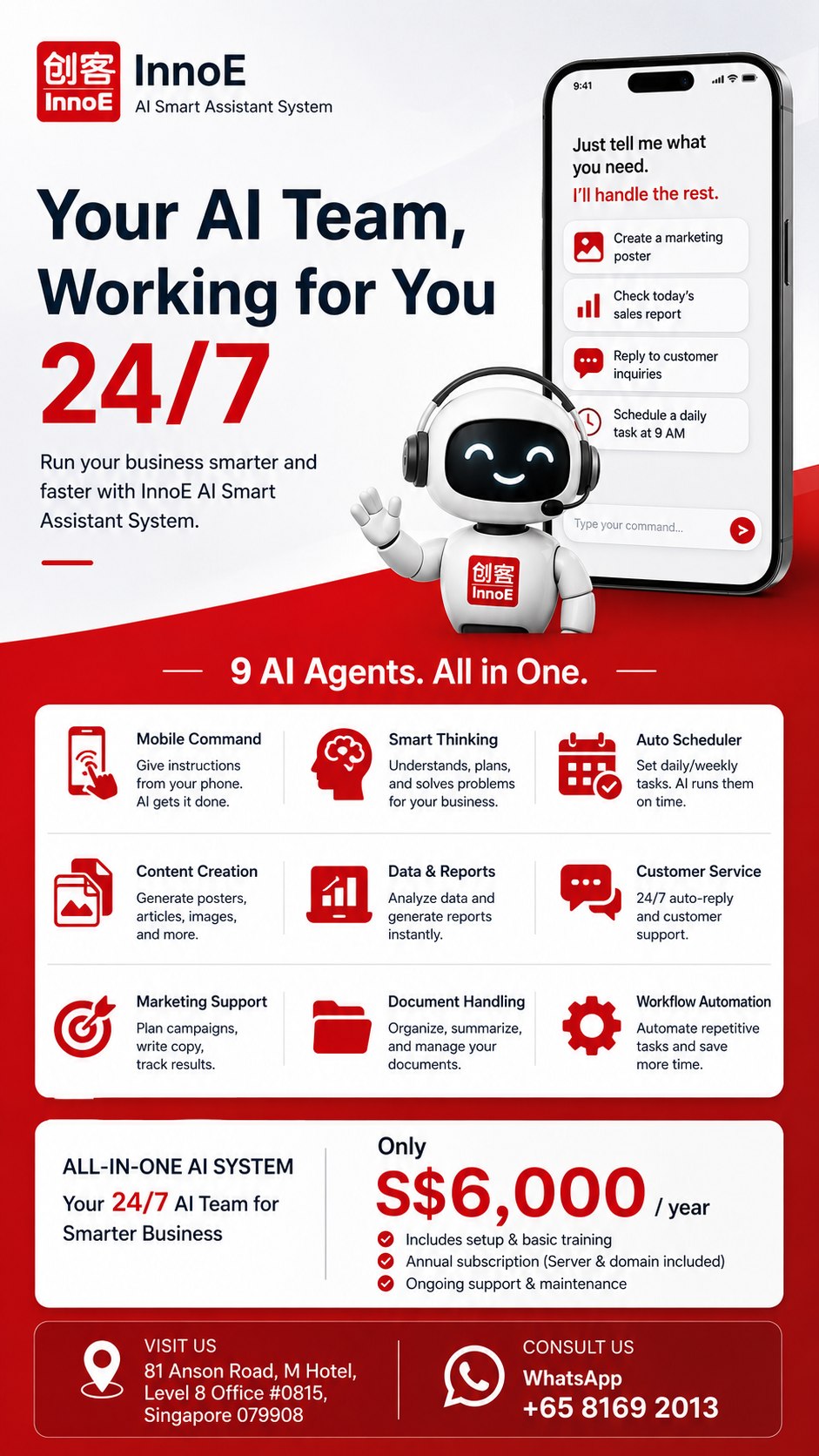
Many business owners already know AI matters. The real barriers are more practical: there is no time to learn another platform, there are too many disconnected tools, and most AI products still do not fit the way the business actually operates.
If the owner still has to chase enquiries, search through files, check income and expenses, update the website, and remind the team about recurring tasks, opening another AI chat window does not solve the problem.
InnoE’s AI Smart Assistant System is designed around a different idea: the owner should not have to become an AI expert. The system is configured around the company, so the team can give instructions in everyday language—from a phone or computer—and use AI to support real work.
The goal is not to give your business one more AI tool. The goal is to give it an AI team that understands the task, works with approved business information, and helps move the work forward.
Why AI tools often fail to create real business efficiency
The problem is usually fragmentation. The website sits with one provider, customer enquiries arrive on several channels, financial records live in spreadsheets, and company knowledge is scattered across staff devices and chat groups.
That creates familiar operational pain:
- A customer enquires after hours and receives no timely reply.
- Staff answer the same questions repeatedly instead of focusing on higher-value work.
- Receipts, income, expenses, and notes are spread across paper, chat messages, and files.
- Every small website update requires technical help and waiting time.
- Important company knowledge depends on individual employees.
- Owners spend hours following up but still lack a clear view of what is happening.
A business does not need its tenth standalone AI app. It needs a connected system designed around its own information, workflows, and priorities.
One system connecting four core business modules
Depending on the company’s needs, InnoE can combine an AI agent, business website, internal income and expense management, and website AI customer service into one practical operating setup.
1. A dedicated AI agent: assign work directly from your phone
Owners and employees can use natural instructions such as:
- “Summarise today’s customer enquiries and identify the priority leads.”
- “Create an English marketing post based on this product information.”
- “Prepare a clear summary of this week’s business data.”
- “Remind me every morning about the items that require follow-up.”
The assistant is not limited to answering questions. Based on the approved setup, it can help analyse information, organise files, draft content, schedule reminders, and support recurring tasks. The system is configured around real working habits, so the team can start using it without learning programming or complicated prompt techniques.
2. Business website: turn your online presence into a working sales asset
A company website should be more than a digital name card. It should explain the brand, present services clearly, guide visitors to the next step, and remain available around the clock.
InnoE can support website setup and management, including brand and service information, contact details, domain configuration, and server deployment. A more manageable website also reduces the delay caused by relying on external technical support for every small content change.
3. Internal income and expense management: keep operating records in one place
Businesses can organise daily income, expenses, receipts, and transaction notes in a central system instead of searching through paper records, chat messages, and multiple Excel files. Basic internal reports can make cash movement and operating activity easier for the owner to understand.
This module is intended to improve internal record-keeping and visibility. Formal accounting, tax filing, audit decisions, and professional financial advice should still be handled by qualified professionals.
4. Website AI customer service: respond around the clock
The website AI assistant can answer common enquiries using company-approved information, collect lead details, and help visitors find the right service. When a request is complex, it can organise the customer’s needs and refer the case for professional follow-up.
The purpose is not to replace sales professionals. It is to reduce repetitive replies, shorten response time, and help the team focus on qualified leads, complex solutions, and closing opportunities.
Six capabilities that turn AI from a chatbot into a working assistant
The project focuses on six practical capabilities:
- Mobile command — assign tasks in everyday language from your phone.
- Smart analysis — understand requirements, organise information, and support decisions.
- Business website — present the company clearly and manage content more efficiently.
- Internal records — centralise basic income, expense, receipt, and operating information.
- Automated execution — schedule reminders and support recurring tasks.
- AI customer service — receive website enquiries, answer common questions, and collect leads 24/7.
The value comes from making these capabilities work together around the same business goals—not from adding flashy features that remain disconnected from daily operations.
Why a dedicated system is more useful than a public chatbot
General AI tools are built for everyone. A business assistant should understand a specific company’s services, knowledge, communication style, access boundaries, and workflow.
Depending on the agreed scope, implementation support can include:
- organising a company knowledge base;
- basic user training;
- launch and onboarding support;
- access from mobile and desktop;
- configuration based on the company’s actual needs;
- planning information access and usage boundaries.
This gives the company a more structured way to use AI within approved information and rules, rather than asking employees to experiment independently with public chat tools.
Which businesses should consider starting now?
This system is especially relevant when:
- a small team handles many repetitive customer and administrative tasks;
- the owner personally manages the website, follow-ups, and internal information;
- business knowledge is scattered and needs to become a usable company knowledge base;
- income and expense records still rely on paper, messages, or multiple spreadsheets;
- the company wants to adopt AI but does not have an internal technical team;
- management prefers to solve one urgent pain point first and expand gradually.
Education, professional services, consulting, retail, food and beverage, trading, and other Singapore SMEs can each adopt a different configuration based on their workflow.
Implementation is not just software installation
A practical rollout begins by understanding how the business currently works: where enquiries come from, which questions are repeated most often, where information is stored, which tasks consume the most time, and who needs access.
A typical implementation path includes:
- Needs assessment — identify the processes that waste time, lose leads, or reduce visibility.
- System configuration — set up the required modules, business knowledge, and working rules.
- Testing and training — let actual users test the system and refine its responses and actions.
- Launch support — put the system into daily use and improve it based on real feedback.
A company may begin with one module or combine several modules. Final features, implementation scope, timeline, and fees are confirmed after consultation.
AI should reduce the owner’s workload—not create a new subject to study
The business case for AI is simple: reduce repetitive work, respond to customers faster, centralise useful information, and make operations easier to understand.
If your company is dealing with too many tasks, a limited team, scattered information, or slow customer response, the best first step is an AI needs assessment. Start with the most valuable workflow, make it work properly, and then expand.
Explore the Enterprise AI Smart Assistant solution
Book an AI needs assessment on WhatsApp
InnoE Holdings Pte Ltd | Singapore
WhatsApp: +65 81809045